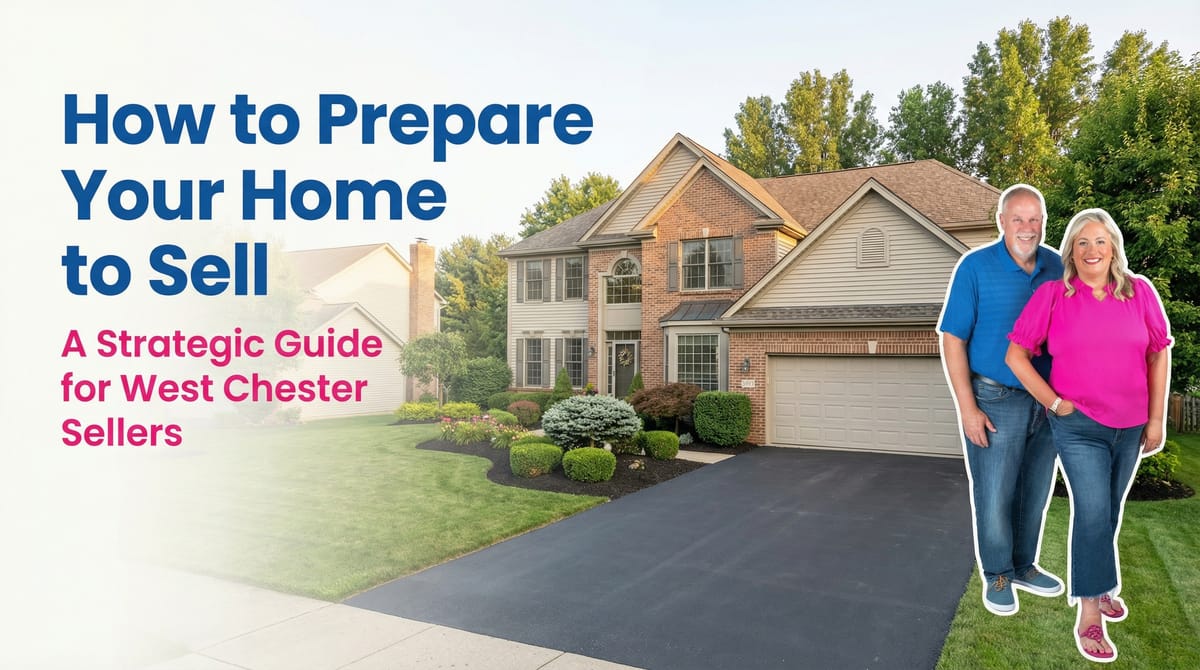
What to Do Before Selling Your Home in West Chester, Ohio (A Strategic Seller's Guide)
Most sellers in West Chester don't lose money at the closing table — they lose it in the weeks before they list. Here's how to prepare strategically, protect your equity, and go to market with confidence.
There's a version of this process that feels scrambled — last-minute touch-ups, rushed pricing conversations, a listing that goes live before the home is actually ready. And then there's the version where everything is sequenced intentionally: the prep is done with ROI in mind, the pricing is grounded in real data, and the marketing launches with momentum behind it.
If you're thinking about selling your home in West Chester — whether that's in a neighborhood like Foxborough, closer to Liberty Township, or somewhere along the Butler County corridor — the difference between those two versions almost always comes down to what you do before you list.
This guide walks you through the steps that actually matter.
Step 1: Get a Realistic Picture of Where the Market Stands Today
The West Chester and greater Cincinnati–Dayton market has continued to shift since the low-inventory frenzy of 2021. Buyers in the $400K–$700K range are still active, but they're more measured now — more sensitive to pricing, more likely to walk away from a home that's been sitting, and more informed about what comparable homes have sold for.
Before you make a single decision about prep or pricing, you need current data: days on market in your price range, recent list-to-sale price ratios, active inventory, and how buyer demand has moved in the last 60 to 90 days. This isn't information you need to find on your own — it's the first thing we walk through with every seller in our initial consultation.
What you're looking for is a grounded, honest read of what the market will actually support — not what your neighbor's house sold for two years ago, and not what Zillow's automated estimate says today.
Step 2: Have a Pricing Conversation Before You Do Anything Else
This step surprises a lot of sellers, but it matters: pricing should inform your prep decisions, not come after them.
Here's why. If you spend $15,000 updating a kitchen in a neighborhood where buyers are already paying a premium for move-in-ready homes in the mid-$500s, that investment may return well. But if your home is realistically positioned at $420K in a segment where buyers are value-sensitive and negotiating hard, that same $15,000 may not come back at closing.
Our pricing philosophy is straightforward: price it to lead the market, not chase it. That means using current local data — not emotion, not hope, not what you need — to identify the position that generates maximum buyer attention in the first two weeks of listing. Homes that are priced right from day one sell faster and, more often than not, for more money than homes that start too high and reduce later.
We talk about this with every seller before a single repair is made, a single contractor is called, or a single photo is taken.
Step 3: Prepare Strategically — Not Comprehensively
There's a meaningful difference between getting your home ready to sell and getting it perfect. Most sellers don't need to do everything — they need to do the right things.
The improvements that consistently pay off in the West Chester market:
- Curb appeal — first impressions form online, before a buyer ever sets foot in your driveway. Fresh mulch, a clean driveway, trimmed landscaping, and a well-maintained front entry are high-ROI, low-cost.
- Interior paint — neutral, updated paint throughout (especially if your current colors are dated or bold) signals move-in readiness to buyers.
- Lighting — replace dated fixtures, add brightness to darker rooms. Buyers notice light.
- Declutter and depersonalize — this isn't staging; it's math. Every unnecessary item in a room shrinks the perceived space. Less is almost always more.
- Mechanical transparency — if your HVAC, water heater, or roof is aging, you don't necessarily need to replace it, but you should be prepared to document its condition and address it proactively.
What you can often skip: full kitchen or bathroom remodels (rarely dollar-for-dollar at today's prices), cosmetic changes that reflect your taste rather than buyer expectations, and anything that takes more than a few weeks to complete and delays your launch.
Scott's background in construction means we can walk through a home and tell you honestly what a buyer's inspector is likely to flag — and more importantly, what's worth addressing ahead of time versus what's negotiable at the defect notice stage. That insight alone often saves sellers thousands.
We also have a vetted network of contractors in the West Chester area who work efficiently and at fair prices, so you're not scrambling to find someone reliable on your own.
Step 4: Understand What Professional Marketing Actually Looks Like
This is where a lot of sellers assume all agents are essentially doing the same thing. They're not.
For every listing, we execute a 150+ point marketing plan that covers professional photography, compelling listing copy, MLS and portal syndication, targeted social promotion, geo-farm outreach to the surrounding neighborhood, and — critically — reverse prospecting: actively identifying and reaching out to buyer agents whose clients are already searching in your price range and zip code.
We also schedule two planned open houses per listing, with door-hanger invitations sent into the neighborhood beforehand. That combination of digital reach and local presence is intentional — it creates multiple points of contact with likely buyers, not just passive waiting.
Every week your home is on the market, you receive a written performance report: views, clicks, showings, feedback. You're never left wondering what's happening.
This is the full-launch approach we execute on every listing, regardless of price point.
Step 5: Think Through Your Timeline — Especially If You're Also Buying
This is one of the most under-discussed parts of the pre-listing process. If you're selling your West Chester home and planning to buy something else — whether that's a move-up purchase, a downsize, or a relocation — the sequencing of those two transactions has real financial and logistical implications.
Questions worth working through before you list:
- Do you buy first, or sell first?
- What does your equity position look like, and how does that affect your purchase options?
- What kind of contingency protections do you need in place?
- Is bridge financing or a rent-back arrangement a fit for your situation?
There's no universal right answer. The right approach depends on your financial position, your risk tolerance, your target price range for the purchase, and what inventory looks like on the buy side. We've helped a lot of West Chester-area clients navigate this — and the ones who think it through early make far fewer reactive decisions under pressure later.
Step 6: Build Your Team Before You Need Them
The sellers who have the smoothest transactions are the ones who didn't have to figure everything out mid-process. Before you list, it helps to have clarity on:
- Your agent team — who's leading listing strategy (Jill), who's handling negotiation and buyer-side coordination (Scott), and how communication flows week to week
- Your closing attorney or title company — especially if you've been in your home for years and haven't been through a transaction recently
- Your contractor contacts — for any pre-listing prep and for responding to inspection findings quickly if needed
- Your mortgage lender — if you're purchasing simultaneously, pre-approval on the buy side should happen in parallel with your listing prep, not after
Having these relationships in place means that when things move quickly — and in West Chester, they often do — you're not scrambling.
What This Process Looks Like in Practice
We recently worked with a couple in West Chester who were planning to downsize after 18 years in their home. They came to us convinced they needed to do a full kitchen renovation before listing. After walking through the home together and reviewing the comps, we advised them to skip the renovation and instead focus on paint, lighting, landscaping, and a deep clean — total investment under $4,000.
The home launched with professional photography and targeted outreach to buyer agents in the $525K–$575K corridor. It received multiple offers within the first week and sold above asking price. They also found their next home before closing, which we coordinated with a rent-back arrangement that gave them the flexibility to move without pressure.
That outcome didn't happen by accident. It happened because the right decisions were made before the sign went in the yard.
Frequently Asked Questions: Selling Your Home in West Chester, Ohio
How far in advance should I start preparing to sell my home in West Chester? Most sellers benefit from starting the conversation 60 to 90 days before their target list date. This gives enough time to complete strategic prep, address any contractor timelines, and build out the marketing launch properly — without rushing decisions that affect your outcome.
Do I need to renovate before listing my West Chester home? In most cases, no. The improvements that move the needle most are typically cosmetic: paint, landscaping, lighting, and decluttering. Full renovations rarely return dollar-for-dollar in today's market. A pre-listing walkthrough with an experienced agent can help you focus spending where it actually matters.
How is pricing determined for homes in West Chester? We use current local data — active inventory, recent sales, days on market, and price reduction trends in your specific price range — to recommend a pricing strategy. The goal is to position your home to lead the market, which generates stronger early demand and typically better final outcomes than starting high and reducing later.
What if I need to buy a new home at the same time I'm selling? This is very manageable with the right plan in place. The key is working through the sequencing — buy first vs. sell first, contingency options, bridge financing, rent-back arrangements — before you list, not in the middle of a transaction. We guide sellers through this regularly.
What does your marketing plan include for West Chester listings? Every listing includes professional photography, MLS and major portal syndication, targeted social promotion, neighborhood geo-farm outreach, reverse prospecting to find active buyers, two planned open houses with neighborhood door-hanger invitations, and weekly written performance reports.
💬 "Scott and Jill were incredibly organized from day one. They told us exactly what to fix, what to skip, and why. We didn't waste a dollar on prep that didn't matter — and the house sold in a week for more than we expected."
— Sellers in West Chester, OH
The Bottom Line
What you do before you list your West Chester home — how you price it, how you prepare it, and how you launch it — shapes everything that follows. Sellers who approach this with a clear, sequenced plan consistently come out ahead of sellers who are improvising under pressure.
If you're thinking about selling in West Chester, Liberty Township, Monroe, or anywhere in the Cincinnati–Dayton corridor, we'd be glad to walk through your situation before you commit to anything. No obligation, no pressure — just a straightforward conversation about what the market looks like and what a smart plan would include for your home specifically.
💬 "We didn't know where to start, and Scott and Jill gave us a clear roadmap from our very first conversation. They knew the West Chester market inside and out and made the whole process feel manageable."
— Move-up sellers, West Chester to Mason
Ready to talk through your situation? Reach out to Scott and Jill Ferguson at Spouses Who Sell Houses — serving West Chester, Liberty Township, Monroe, Mason, Lebanon, Springboro, and the greater Cincinnati–Dayton corridor.
The information in this post is intended for general educational purposes. Market conditions change frequently. For guidance specific to your home and situation, please consult directly with a licensed real estate professional.