Which Home Improvements Actually Boost Resale Value in West Chester and the Dayton Area?
Not every upgrade pays off at the closing table. Here's how equity-rich sellers in the Cincinnati–Dayton corridor can invest strategically — and what the 2025 data actually says about ROI.
You've lived in your home for years. You've taken good care of it, kept up with repairs, and maybe even tackled a project or two along the way. Now you're thinking about listing — and suddenly everyone has an opinion about what you should fix, update, or remodel before you do.
The kitchen. The bathrooms. New flooring. A fresh coat of paint on everything. It can start to feel like the list is endless, and the price tag keeps climbing before you've listed a single room.
Here's what we tell sellers in West Chester, Monroe, Mason, and across the Dayton corridor: not every upgrade pays off at the closing table. The goal isn't to renovate your home — it's to position it strategically. That means spending where buyers are paying attention and stopping before you spend money that the market won't give back.
Start With the Data, Not the Pinterest Board
Every year, Zonda publishes the Cost vs. Value report, which tracks how common remodeling projects perform at resale across 119 U.S. markets. The 2025 edition tells a consistent story: exterior improvements — especially ones that affect a buyer's very first impression — deliver the strongest returns.
In fact, eight of the top ten highest-ROI projects in the 2025 report are exterior upgrades. Three projects in particular stand out:
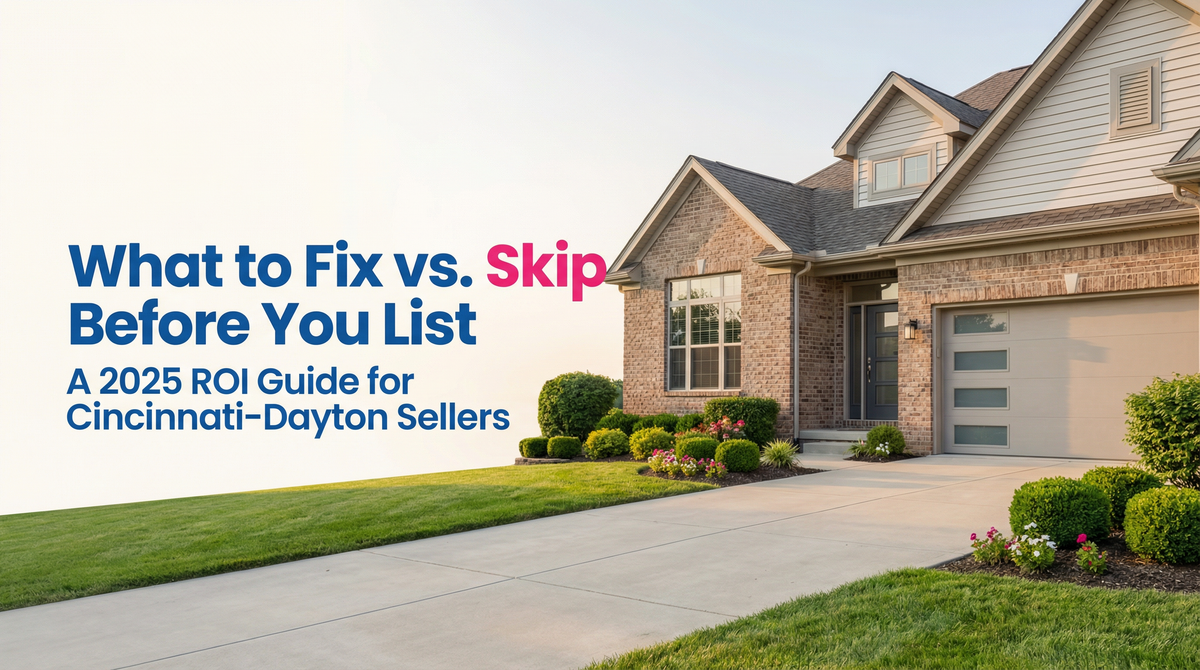
Garage door replacement held the top spot for the second year in a row. A new garage door covering roughly one-third of your home's front-facing view signals "well-maintained" before a buyer ever steps out of their car. The numbers back that up.
Steel entry door replacement ranked second, with returns that often exceed double the project cost. It's one of the most affordable upgrades a seller can make — and one of the most visible.
Manufactured stone veneer came in third. Adding stone accents to a home's exterior facade updates its appearance meaningfully and tends to appeal broadly across buyer types, which is exactly what you want when you're trying to attract the widest pool of interested buyers.
The takeaway from the data is straightforward: buyers form their opinion of a home before they walk through the front door. Curb appeal isn't a soft concept — it's measurable, and it moves the needle on what buyers are willing to offer.
What About the Kitchen and Bathrooms?
Kitchen and bathroom updates are where sellers most often over-invest. That's not a reason to ignore them — it's a reason to be precise.
The 2025 Cost vs. Value report shows that minor kitchen remodels — cabinet refacing, updated countertops, refreshed hardware, and a new appliance or two — returned roughly 113% of their cost nationally. That's a strong number. What it reflects is that buyers respond well to kitchens that look clean, modern, and functional. They are not paying a premium for custom cabinetry or a layout redesign that required permits.
A midrange bathroom remodel — updated fixtures, fresh tile, a new vanity — typically returns in the range of 74–93% depending on the market. In a corridor like ours, where buyers are comparing similarly priced homes in West Chester, Springboro, Mason, and Lebanon side by side, an updated bathroom helps your home feel move-in ready rather than a project. That matters.
What doesn't tend to pay off: major kitchen overhauls, luxury bath additions, and large-scale renovations that are highly personalized. The more a remodel reflects your taste rather than broad buyer appeal, the less predictable the return. Buyers may admire it — but they won't necessarily pay extra for it.
The Ohio Context: Costs Have Risen
One thing worth noting for sellers in our market: remodeling costs in Ohio have increased significantly over the past several years. Material costs, labor availability, and supply chain pressure have all contributed. What a minor kitchen refresh cost three years ago is not what it costs today.
That context matters when you're evaluating whether to take on a project before listing. An upgrade that might have had an easy ROI calculation a few years back may now require a harder look at whether the investment will be returned at the price point your home is likely to command.
This is exactly why we walk through pre-listing improvements during our strategic consult — before any money is spent. The goal is always to identify where targeted investment will produce a measurable return, and where the better path is strategic pricing and strong marketing rather than a renovation budget.
What to Fix vs. What to Skip: A Practical Framework
When we work with sellers in West Chester, Monroe, or Mason, we generally think about pre-listing improvements in three categories:
Do it — it pays: Garage door replacement, front door update, exterior touch-up and landscaping, fresh neutral paint, professional cleaning, and decluttering. These are low-to-moderate cost items with high visual impact. They show up in listing photos, in buyer walkthroughs, and in the offers you receive.
Be selective: Minor kitchen updates, bathroom refreshes, and flooring replacement in high-traffic areas. These make sense when the existing condition would show poorly in photos or create an easy objection during showings. They don't make sense when they're discretionary — when the space is dated but functional and you'd be spending $20,000 hoping to recover $18,000.
Skip it: Major remodels, luxury upgrades, pool additions, room additions, and anything that takes months to complete. These projects are for people who plan to stay — not sellers who need to protect their net proceeds.
One more principle we apply: don't over-improve for your neighborhood. If homes on your street are topping out at a certain price point, a $60,000 kitchen remodel will not push your home beyond the neighborhood ceiling. Buyers are comparing your home to others nearby — and they have a sense of what "right" looks like at each price level.
What This Looks Like in Practice
We recently worked with a seller in Monroe who was considering a full bathroom remodel before listing. The home was well-maintained, in a desirable neighborhood, and priced in the mid-$400s. The bathroom in question was dated but fully functional.
After walking through the space together and reviewing comparable sales, we advised against the full remodel. Instead, we suggested a targeted refresh — new light fixtures, a fresh vanity mirror, updated hardware, and a deep professional clean. The cost was a small fraction of what a full gut-and-replace would have run.
The home sold in under two weeks, above asking price, with multiple offers. The updated fixtures helped the bathroom photograph well and show cleanly. The buyer was going to update it eventually on their own terms anyway — and they paid well for the privilege.
That's the outcome a strategic approach produces. Not always a renovation. Sometimes restraint, paired with excellent marketing and pricing, is the smarter move.
A Note on Our Process
Part of how we help sellers avoid over-spending on pre-listing prep is through the Ready phase of our Ready, List, Sell process. Before any project begins, we walk through the property together, identify what buyers in your price range will actually care about, and offer introductions to vetted contractors who understand how to execute efficiently — not over-build.
Scott's background in construction and hands-on understanding of how homes are put together is genuinely useful here. He can walk a property and quickly identify what's cosmetic, what's structural, and what's likely to come up in an inspection — so we're never caught off guard, and sellers aren't spending money fixing things that buyers won't notice or care about.
If you're thinking about listing your home in West Chester, Mason, Monroe, or anywhere in the Cincinnati–Dayton corridor and want a clear-eyed assessment of what's worth doing before you go to market, let's start a conversation. No pressure, no obligation — just a practical look at your specific situation.
You can also get a sense of what to expect from the pre-listing process and what strong listing preparation actually looks like in this market.
Frequently Asked Questions
Which home improvements have the best ROI before selling? According to the 2025 Cost vs. Value report, garage door replacement, steel entry door replacement, and manufactured stone veneer deliver the highest returns — often more than doubling the project cost at resale.
Is it worth remodeling a kitchen before selling? A minor kitchen refresh — updated cabinets, countertops, and hardware — typically returns around 113% of its cost. Full gut remodels rarely pay off and often cost more than the market will return, especially in mid-range price tiers.
What should I skip before listing my home? Major remodels, pools, room additions, and highly personalized upgrades rarely return their investment. Focus instead on curb appeal, cosmetic updates, and anything that affects how your home shows in photos and in person.
Does the Cincinnati–Dayton market respond differently to upgrades? Local market conditions matter. In our corridor, buyers are often comparing similar homes in neighboring communities, so appearing move-in ready at a competitive price point is more important than featuring premium upgrades.
How do I know what's worth doing before I list? A pre-listing consultation with experienced local agents is the most reliable way to assess this. Understanding what buyers in your price range actually value — versus what sounds good in theory — prevents over-spending.
This content is intended for general informational purposes only and does not constitute financial, legal, or real estate advice. Market conditions vary. Consult a licensed real estate professional for guidance specific to your property and situation. Scott & Jill Ferguson are licensed REALTORS® in the state of Ohio.